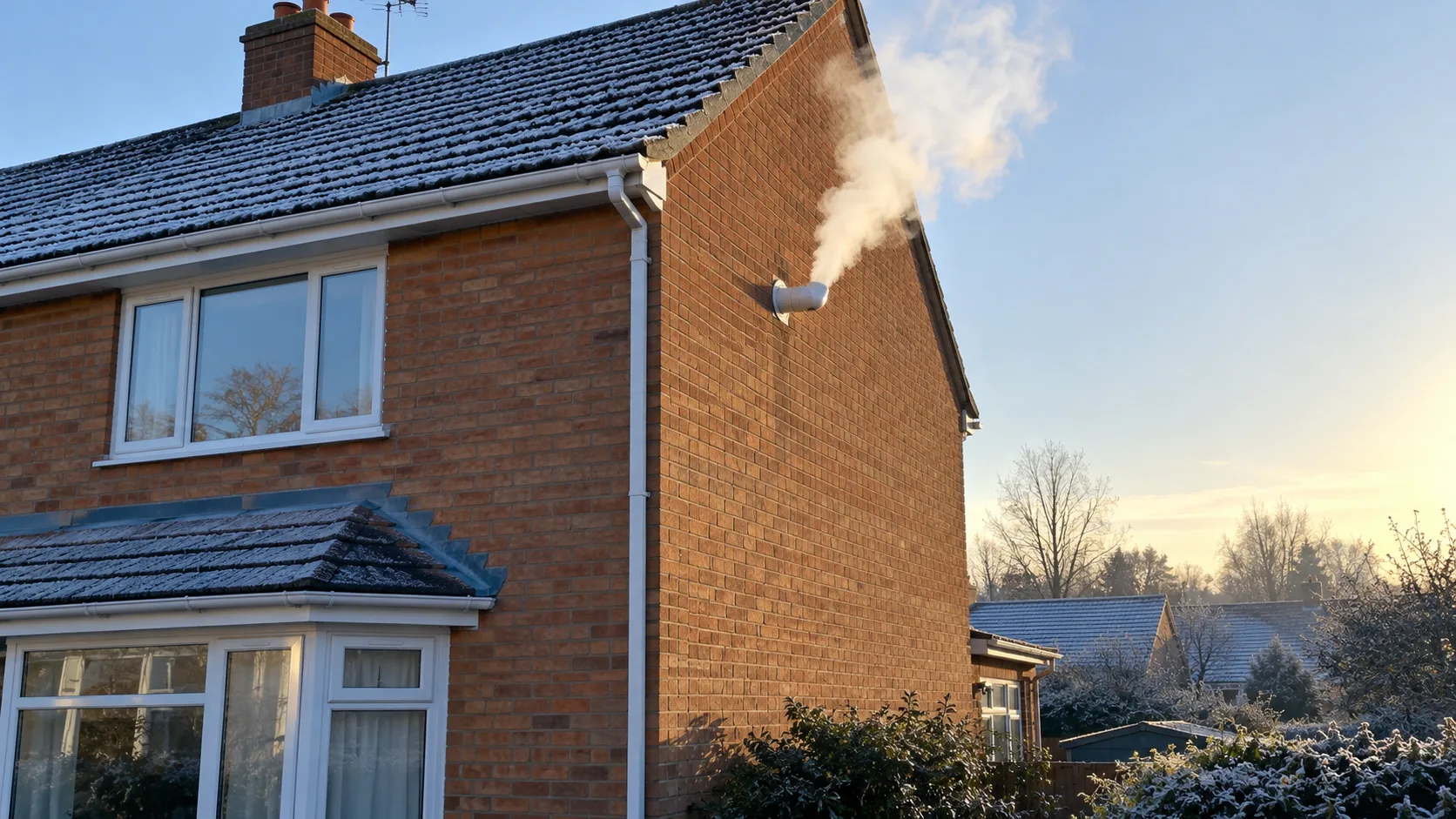
Steam from your boiler flue on a cold day is almost always normal. Condensing boilers, whether they run on mains gas, LPG or oil, push out warm, damp air, and in cold weather it turns into a visible white cloud called a plume. You’ll see far more of it in November than in July. It’s only a concern if the plume is dark or smoky, smells of fumes, leaves soot, or arrives with a fault on the boiler. Our boiler installation team covers Oxford and Bicester.
Why condensing boilers make a plume
A condensing boiler gets more heat out of its fuel by cooling the exhaust gases until the water vapour in them turns back into liquid. That water drains away through the condensate pipe. Some vapour still leaves through the flue, and when warm, moist air meets cold outside air, it condenses into a cloud, just like your breath on a frosty morning.
Older non-condensing boilers sent out hotter, drier gases, so their plume was less obvious. That’s why people who’ve had a new boiler fitted often notice it for the first time in winter.
When a plume is normal
- It’s white and wispy, and clears quickly
- It’s bigger on cold, damp or still days
- It appears when the heating or hot water is running and stops soon after
- The boiler is working normally, with no fault codes or unusual noises
Signs something isn’t right
Turn the boiler off and call a Gas Safe registered engineer, or an OFTEC registered technician for oil, if you notice:
- Grey, black or yellowish smoke rather than white vapour
- A smell of fumes near the flue or inside the house
- Soot or black marks around the flue terminal or on the wall
- The boiler locking out, showing fault codes or not heating properly
- Water pouring from the flue itself
- Your carbon monoxide alarm going off
If your CO alarm sounds, open windows, turn the boiler off, get everyone outside and call for help. If you smell gas, leave the property and call the National Gas Emergency Service on 0800 111 999. For LPG, you can also call your supplier’s emergency number.
Never block or redirect the flue yourself
It can be tempting to deal with a plume that drifts towards a window, a path or a neighbour’s garden by covering or bending the flue. Don’t. Flues have to meet strict rules on where they sit and how far they are from openings and boundaries, so that fumes disperse safely. Blocking or altering one, even partly, can push dangerous gases back indoors.
Keep the area round the terminal clear of plants, stored items and snow.
When the plume is a nuisance
If the plume blows across a door, window, path or a neighbour’s property, there are proper fixes. An engineer can fit a plume management kit, which moves the point where the vapour comes out, or in some cases move the flue. This has to be done by a qualified engineer using parts approved for your boiler. It’s often easiest to plan when a new boiler is going in, which is something we look at during the survey.
Flues and plumes in Oxfordshire homes
Terraces and semis in Oxford, Bicester and Witney often have flues close to a side path, a boundary or a neighbour’s window, so the plume is easy to notice. Rural homes on LPG or oil may have a condensing boiler in a utility room or outbuilding, with a flue near a yard or garden. In any of those cases, an annual service includes a check of the flue and how cleanly the boiler is burning. If your boiler runs on LPG, our page on LPG boiler installation covers the systems we fit.
Frequently asked questions
Is steam from my boiler flue dangerous?
Usually not. A white plume from a condensing boiler is water vapour and is normal in cold weather. It’s a concern if it’s dark, smells of fumes, leaves soot or comes with a boiler fault. In that case, turn the boiler off and have it checked by a Gas Safe or OFTEC registered engineer.
Why is my new boiler steaming more than my old one?
Modern condensing boilers produce cooler, wetter exhaust than older non-condensing models, so the plume is more visible, especially on cold, damp days. That’s a sign the boiler is condensing and running efficiently. If it’s also making odd noises or showing faults, ask an engineer to check it.
Do oil and LPG boilers make a plume too?
Yes. Condensing oil and LPG boilers work in the same way as condensing gas boilers, so they also produce a visible plume in cold weather. The same rules apply: a white plume is normal, while smoke, soot or a smell of fumes needs checking by a qualified engineer.
Not sure about the steam from your flue?
Give us a call on 01865 602 994 or drop us a message and we’ll check your boiler and flue and let you know if anything needs doing.